

Some of the links in this post are affiliate links. This means if you click on the link & purchase the item, I will receive an affiliate commission at no extra cost to you. All opinions remain my own.
Finding a Golden Retriever puppy is exciting, but choosing the right breeder takes some research.
To find a reputable Golden Retriever breeder, you’ll want to look beyond a website or available litter. Take time to research the breeder, ask questions, review health clearances, and learn how their puppies are raised.
Not sure where to start? This guide will walk you through what to look for, what to ask, and the red flags to watch for.
Table of Contents
What Makes a Golden Retriever Breeder Reputable?
A reputable Golden Retriever breeder puts the health, temperament, and well-being of their dogs first. They carefully choose their breeding dogs, provide proper care for their puppies, and care about where their puppies end up.
Look for a breeder who:
- Health tests their breeding dogs for conditions common to Golden Retrievers.
- Prioritizes temperament when choosing which dogs to breed.
- Knows the breed well and can answer your questions.
- Raises puppies in a clean, safe environment.
- Socializes puppies before they go to their new homes.
- Provides proper veterinary care and keeps good records.
- Is open about their dogs, including the parents and health clearances.
- Uses a written puppy contract.
- Stays available for support after you bring your puppy home.
- Cares about where their puppies go and asks you questions about your home and lifestyle.
A breeder doesn’t have to be perfect. But they should be transparent, knowledgeable, and genuinely concerned about the dogs they produce.
Where Can You Find a Golden Retriever Breeder?
A good place to find a Golden Retriever breeder is through an official kennel club or Golden Retriever breed club. You can also find breeders through recommendations and local dog events.
Here are some places to start your search:
- American Kennel Club (AKC): If you’re in the United States, the AKC provides resources for finding Golden Retriever breeders and learning more about the breed.
- Canadian Kennel Club (CKC): If you’re in Canada, the CKC provides information about registered breeders and Golden Retrievers, along with resources for responsible dog ownership.
- The Kennel Club: For readers in the United Kingdom, The Kennel Club provides information about Golden Retrievers and resources for finding breeders in the UK.
Remember: Being listed by a kennel club or breed club doesn’t automatically make a breeder reputable. You’ll still need to research them carefully before choosing one.
Other Ways to Find Breeders
You can also look for breeders through:
- Golden Retriever owners
- Veterinarians
- Local dog clubs
- Dog shows and events
Tip: Talk to other Golden Retriever owners. If you see a Golden Retriever you love, ask the owner where they got their dog. Most owners are happy to share their experience.
How Should You Research a Golden Retriever Breeder?

Before contacting a breeder or sending a deposit, take some time to research their breeding program, their dogs, and their reputation. A little research can tell you a lot about whether a breeder is worth pursuing.
Look at Their Breeding Program
Visit the breeder’s website and look for information about:
- How long they’ve been breeding Golden Retrievers
- Their breeding goals: Are they breeding for health, temperament, or working ability?
- Their adult dogs
- Current and past litters
- Health testing
- Puppy care and socialization
A good breeder should be open about their breeding program and the dogs they produce.
Research the Parents
Find out as much as you can about the puppy’s parents.
Look for:
- The sire and dam’s names
- Health clearances
- Pedigree information: The puppy’s family tree, showing its parents, grandparents, and other ancestors.
- Temperament
- Previous litters, if applicable
Don’t be afraid to ask the breeder for more information if you can’t find it yourself.
Look for Reviews and References
Reviews can give you an idea of what other puppy buyers experienced.
You can also ask the breeder whether they have previous puppy buyers willing to share their experience.
Note: A handful of positive reviews doesn’t prove a breeder is reputable. Look at the bigger picture and consider everything you’ve learned so far.
What Health Testing Should a Golden Retriever Breeder Have?
A reputable Golden Retriever breeder should screen their breeding dogs for common health problems affecting the hips, elbows, eyes, and heart.
Here are the main health clearances to look for:
- Hips: Hip dysplasia can affect Golden Retrievers, so the parents should have their hips evaluated.
- Elbows: Elbow dysplasia is another concern in Goldens. The parents should have their elbows evaluated as well.
- Eyes: The parents should have their eyes examined by a qualified veterinary ophthalmologist.
- Heart: Golden Retrievers can develop inherited heart conditions, so the parents should have appropriate heart screening.
- Genetic testing: Breeders can use DNA testing to check for certain inherited conditions and make informed breeding decisions.
These aren’t just routine vet checkups. They’re specific health screenings recommended for Golden Retrievers. The Golden Retriever Club of America has more information on the health screenings recommended for breeding dogs.
Ask to See the Health Clearances
Don’t be afraid to ask the breeder for proof.
Ask to see the health clearances for both the mother and father of the litter.
A reputable breeder should be happy to share them.
Tip: If a breeder tells you their dogs are health tested but won’t show you the results, I’d consider that a red flag and ask more questions before moving forward.
What Questions Should You Ask a Golden Retriever Breeder?
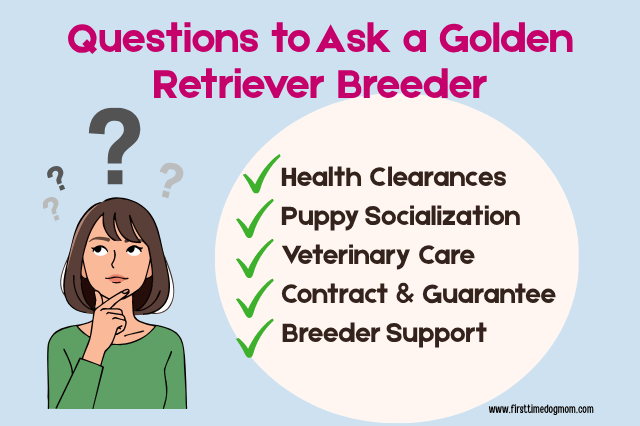
Ask about the parents, puppies, health testing, breeding practices, and what support the breeder provides after you bring your puppy home.
Here are some questions to get the conversation started:
Questions About the Parents
- What health clearances do the parents have?
- Can I see the health clearances?
- What are the parents’ temperaments like?
- How old are the parents?
- Have they had puppies before?
Questions About the Puppies
- Where are the puppies raised?
- How are they socialized?
- What veterinary care will they receive?
- What vaccinations and deworming will they receive?
- How old will the puppies be when they go home?
- What food are they eating?
In general, puppies should stay with their mother and littermates until at least 8 weeks old. Some breeders may keep them a little longer.
Once you’ve found the right breeder, you’ll also need to decide which puppy is the best fit for your family. Learn how to choose a puppy from a litter before making your decision.
Questions About the Breeder
- How long have you been breeding Golden Retrievers?
- What are your goals when choosing which dogs to breed?
- Do you provide a written contract?
- Do you offer a health guarantee?
- What kind of support do you provide after I bring my puppy home?
- What happens if I can no longer keep the dog?
You don’t need to ask all of these questions at once. Think of them as a starting point for a conversation with the breeder.
Pay attention to how they answer, too. A reputable breeder should be willing to answer your questions openly rather than making you feel like you’re being difficult.
A Good Breeder Will Ask You Questions Too
Here’s something you may not expect: a good breeder will ask you plenty of questions, too.
They should want to know where their puppies are going and whether you’re prepared for life with a Golden Retriever.
They may ask about:
- Your home and who lives with you
- Children or other pets
- Your experience with dogs
- Your work schedule
- How much time the puppy will spend alone
- Your plans for training
- What you’re looking for in a Golden Retriever
Don’t take these questions personally. In fact, I’d consider it a good sign.
A good breeder wants to ensure the right match, not just any home, for their puppies. Once yours arrives, learn how to properly socialize your Golden Retriever puppy to help them get off to a good start.
Visit the Breeder
If possible, visit the breeder before bringing your puppy home.
Seeing the dogs and where the puppies are raised can tell you a lot more than a website ever will.
During your visit, pay attention to:
- The adult dogs: Can you meet the mother, and does she look healthy, happy, and well cared for?
- The puppies: Do they appear alert, clean, and comfortable around people?
- The living environment: Is it clean, safe, and appropriate for the dogs?
- The breeder: Do they seem knowledgeable and genuinely interested in their dogs?
- The dogs’ behaviour: How do the dogs interact with the breeder and with you?
You don’t need to expect a perfectly spotless home. Dogs live there, after all.
What matters is that the dogs appear well cared for and that the breeder is open about how they are raised.
If something about the visit makes you uncomfortable, don’t be afraid to walk away and keep looking.
Golden Retriever Breeder Red Flags
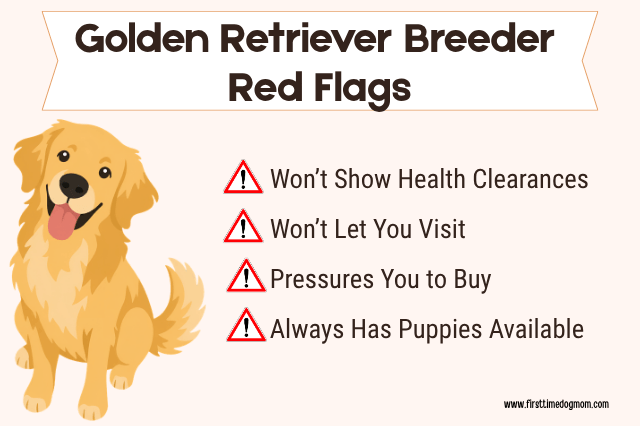
Knowing what to look for in a reputable breeder is important, but it’s just as important to recognize potential red flags.
Be cautious if a breeder:
- Won’t show you health clearances for the parents.
- Avoids questions about the parents, puppies, or breeding program.
- Won’t let you visit or insists on meeting somewhere else without a reasonable explanation.
- Doesn’t ask you questions about your home, lifestyle, or experience with dogs.
- Always has puppies available or seems to have litter after litter.
- Pressures you to send a deposit quickly.
- Doesn’t provide a written puppy contract.
- Seems more interested in making a sale than finding the right home for the puppy.
- Makes you uncomfortable or something just doesn’t feel right.
One red flag doesn’t always tell you the whole story. But if you notice several of these, I’d take a step back and keep looking.
There are plenty of Golden Retriever breeders out there. You don’t have to choose the first one you find.
Don’t Rush to Get a Puppy
It’s easy to get excited when you find a Golden Retriever puppy that’s available right away. But don’t let availability make the decision for you.
Reputable breeders may have waiting lists, and you may need to wait for the right litter or puppy. That’s not necessarily a bad thing. In fact, it can be a good sign that the breeder isn’t constantly producing puppies just to meet demand.
Take your time, do your research, and choose the breeder first. The right puppy is worth waiting for.
How Much Does a Golden Retriever Puppy Cost?
The price of a Golden Retriever puppy can vary quite a bit. As a general ballpark, you may see puppies from reputable breeders priced around $2,000 to $3,500, but prices can vary depending on the breeder, location, pedigree, and what’s included.
When comparing prices, ask what’s included. This may include:
- Veterinary examinations
- Vaccinations and deworming
- Microchipping
- Registration papers
- A health guarantee
- A written puppy contract
A higher price doesn’t automatically mean a better breeder, and a lower price doesn’t necessarily mean a better deal. Look at the breeder as a whole, including their health testing, breeding practices, puppy care, and reputation.
Keep in mind: The purchase price is just the initial cost. You’ll also need to budget for ongoing expenses such as food, veterinary care, grooming, training, and supplies. If you’re getting ready for your first puppy, this new puppy checklist can help you prepare.
Read the Puppy Contract Before Paying a Deposit
Before you pay a deposit or agree to buy a Golden Retriever puppy, read the puppy contract carefully.
A reputable breeder should provide a written contract that explains what you and the breeder have agreed to.
Look for information about:
- The puppy’s health and veterinary care
- Health guarantees and what they cover
- Spay/neuter requirements
- Registration and ownership
- What happens if you can no longer keep the dog
- Any return or rehoming requirements
- What happens if the puppy develops a health problem
The contract may also include specific care requirements. For example, a breeder may ask you to wait until the dog reaches a certain age before spaying or neutering, or recommend that you continue feeding a particular food.
These requirements can vary between breeders, so make sure you understand them before signing the contract or sending a deposit. If something is unclear, ask the breeder to explain it.
Golden Retriever Breeder Checklist
Use this checklist when researching breeders, talking to them, or visiting their home. You can save or print it to help you keep track of what you find.
Before Contacting a Breeder
☐ The breeder is open about their breeding program
☐ They provide information about the parents
☐ The parents have appropriate health clearances
☐ I can find information about previous litters or puppy buyers
☐ The breeder has a good reputation
Questions to Ask
☐ Can I see the parents’ health clearances?
☐ What are the parents’ temperaments like?
☐ How are the puppies raised and socialized?
☐ What veterinary care will the puppies receive?
☐ When can the puppies go home?
☐ Do you provide a written puppy contract?
☐ Do you offer a health guarantee?
☐ What support do you provide after I bring my puppy home?
☐ What happens if I can no longer keep the dog?
When You Visit
☐ The adult dogs appear healthy and well cared for
☐ The puppies appear clean, alert, and comfortable around people
☐ The living environment is clean and safe
☐ The breeder is open and willing to answer questions
☐ I feel comfortable with the breeder and how the dogs are raised
Before Choosing a Breeder
☐ I have reviewed the breeder’s health clearances
☐ I have read the puppy contract
☐ I understand what is included in the puppy’s price
☐ I am comfortable with the breeder’s practices
☐ I don’t feel pressured to make a quick decision
☐ I’m willing to wait for the right breeder and puppy
Remember: You don’t need to check every box to find a good breeder, but if you have concerns about several items, take a step back and do more research before making a decision.
Frequently Asked Questions
Still have questions? Here are a few quick answers.
1. How do I know if a Golden Retriever breeder is reputable?
A reputable breeder prioritizes the health and temperament of their dogs, performs appropriate health testing, raises puppies properly, and cares about where their puppies go.
2. How much should I pay for a Golden Retriever puppy from a reputable breeder?
As a general ballpark, expect to pay around $2,000 to $3,500, although prices vary by breeder, location, pedigree, and what’s included.
3. How long should you wait for a Golden Retriever puppy?
You may need to wait several months, especially if the breeder has a waiting list. Don’t rush your decision just because a puppy is available.
4. What questions should I ask a Golden Retriever breeder?
Ask about the parents, health clearances, puppy care, socialization, veterinary care, and what support the breeder provides after you bring your puppy home.
5. Should you visit a Golden Retriever breeder before buying a puppy?
Yes, if possible. A visit lets you see the dogs and their living environment and meet the breeder in person.
Final Thoughts
Finding a reputable Golden Retriever breeder takes time, but it’s worth doing your homework before choosing a puppy.
Research the breeder, ask plenty of questions, review the health clearances, and visit if you can. Most importantly, don’t feel pressured to make a decision just because a puppy is available.
The right breeder will care about their dogs, their puppies, and the homes they go to. And if something doesn’t feel right, it’s okay to walk away and keep looking.
A healthy, well-socialized Golden Retriever is worth waiting for.
What’s the one red flag that would make you walk away from a breeder?

Hi, I’m Jenny, the owner and content creator of First Time Dog Mom. As the proud owner of Ellie, my senior Golden Retriever, I share the insights and tips I’ve learned through my own experiences as a dog mom. With a lifelong love of animals, I hope to be a helpful resource for others navigating the joys and challenges of pet parenthood.