
Some of the links in this post are affiliate links. This means if you click on the link & purchase the item, I will receive an affiliate commission at no extra cost to you. All opinions remain my own.
Aging Golden Retriever health problems are something many owners worry about as their dog enters the senior years. Dogs, like people, slow down as they age, and your once-energetic golden may sleep more, move slower, or develop a gray muzzle.
Some changes are normal. Others can signal health problems. In this article, we’ll cover common issues, the signs to watch for, and ways to help your senior dog stay healthy and comfortable.
Table of Contents
Common Aging Golden Retriever Health Problems (Quick Overview)
As Golden Retrievers age, some health problems become more common. Here are the most common issues seen in senior Goldens:
- Arthritis and Joint Pain
- Cancer
- Dental Disease
- Heart Disease
- Diabetes
- Vision Problems (cataracts, glaucoma)
- Hearing Loss
- Hypothyroidism
- Cognitive Decline (dog dementia)
Knowing these common issues can help you recognize changes early and get your dog the care they need.
When Is a Golden Retriever Considered a Senior?
Golden Retrievers usually live 10 to 12 years on average.
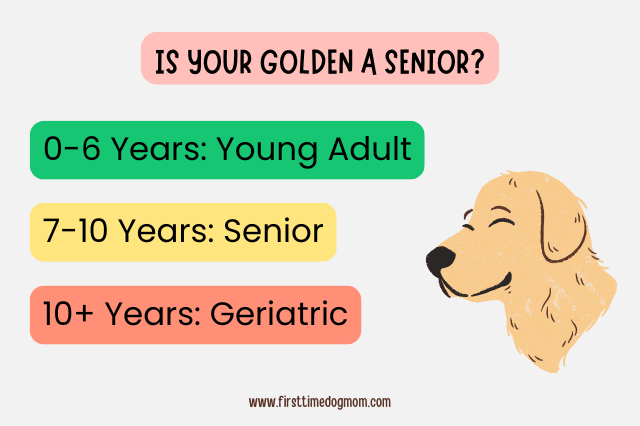
Most Golden Retrievers are considered senior between 7 and 10 years old. This is when age-related changes may start to appear.
Some dogs remain active and energetic during this stage. Others may begin to slow down.
Golden Retrievers 10 years and older are often considered geriatric. At this age, health problems become more common, and your dog may need more support and veterinary care.
Because every dog ages differently, it’s important to watch for physical and behavioural changes as your Golden gets older.
Curious to know how your dog’s age compares to human years? Check out this guide from the AKC on how to calculate dog years to human years.
Common Signs of Aging in Golden Retrievers
Aging happens gradually, and the changes can be subtle at first. As your Golden Retriever gets older, you may notice some differences in behaviour, appearance, or daily habits.
- Slowing Down
Walks may be slower, and they may tire more easily during play. - Sleeping More
Older dogs need more rest and may nap frequently during the day. - Loud Snoring
Many senior Goldens snore more than they did when younger. This is usually normal, but sudden changes or very noisy breathing can be a sign of health issues, so keep an eye on it. - Gray Hair Around the Muzzle
Gray or white fur on the face is a common and noticeable sign of aging. - Stiffness or Difficulty Getting Up
Older dogs may take longer to stand, climb stairs, or jump. This can indicate early joint stiffness or arthritis. - Changes in Hearing or Vision
Your dog may not respond as quickly to sounds or may seem less confident in new places. - Weight Changes
Some dogs gain weight as activity drops, while others may lose weight due to health issues. - Coat and Skin Changes
The coat may thin or become dull, and the skin can become dry or sensitive. Small lumps or skin tags are common. - Loss of Bladder Control
Older dogs may have accidents due to weaker bladder muscles or age-related cognitive changes. Frequent urination or leaking should be checked by your vet.
Many of these changes are a normal part of aging. However, some can also be signs of health problems that become more common in senior dogs.
Common Health Problems in Senior Golden Retrievers
As Golden Retrievers grow older, certain health issues tend to appear more frequently. Being aware of these problems can help you spot changes early and keep your dog comfortable and healthy.
Arthritis
Arthritis is very common in senior dogs. It happens when the joints become inflamed and painful, making movement more difficult.
Common signs:
- Stiffness, especially after resting
- Slower walks
- Trouble getting up or lying down
- Hesitation with stairs or jumping
If your dog seems uncomfortable or reluctant to move, it’s a good idea to speak with your vet.
Cancer
Unfortunately, Golden Retrievers have a higher risk of cancer than many other breeds. Some of the most common types include hemangiosarcoma, lymphoma, melanoma, osteosarcoma, and mast cell tumors. Learn more in our article on Why Golden Retrievers Get Cancer.
Common signs:
- Lumps or bumps
- Unexplained weight loss
- Fatigue or weakness
- Loss of appetite
Any unusual lump or sudden health change should be checked by your vet.
Hypothyroidism
Hypothyroidism occurs when the thyroid gland does not produce enough hormones. This slows down your dog’s metabolism.
Common signs:
- Weight gain without eating more
- Low energy
- Dry skin
- Hair thinning or hair loss
This condition is usually manageable with medication once diagnosed.
Glaucoma
Glaucoma is caused by increased pressure in the eye. It can develop quickly and may lead to vision loss if not treated.
Common signs:
- Red or watery eyes
- Squinting
- Cloudy eyes
- Different pupil sizes
If you notice these signs, contact your vet as soon as possible.
Diabetes
Diabetes affects how your dog’s body controls blood sugar levels. It is more common in middle-aged and senior dogs.
Common signs:
- Increased thirst
- Frequent urination
- Weight changes
- Low energy
Dogs with diabetes can live comfortable lives with proper treatment and monitoring.
Heart Disease
Heart disease becomes more common as dogs get older. It affects how well the heart pumps blood through the body.
Common signs:
- Coughing
- Fatigue during exercise
- Shortness of breath
- Reduced appetite
A vet exam is important if you notice these symptoms.
Muscle Atrophy
Muscle atrophy is the gradual loss of muscle mass that often happens in older dogs.
Common signs:
- Thinner hind legs or hips
- Weakness in the back legs
- Difficulty standing or climbing stairs
Gentle exercise and proper nutrition can help maintain muscle strength.
Dementia (Canine Cognitive Dysfunction)
Some senior dogs develop cognitive decline, which is similar to dementia in humans.
Common signs:
- Confusion or getting lost in the house
- Pacing or restlessness
- Changes in sleep patterns
- Forgetting house training
Your vet may recommend medications or supplements that can help manage symptoms.
Dental Disease
Dental problems are very common in senior Golden Retrievers and can lead to pain, infection, and other health issues if untreated.
Common signs:
- Bad breath
- Red, swollen, or bleeding gums
- Loose or broken teeth
- Difficulty eating or chewing
Regular brushing, dental chews, and professional cleanings can help prevent problems. If you’re unsure where to start, see our Dental Guide for Golden Retrievers.
Caring For Your Aging Golden Retriever
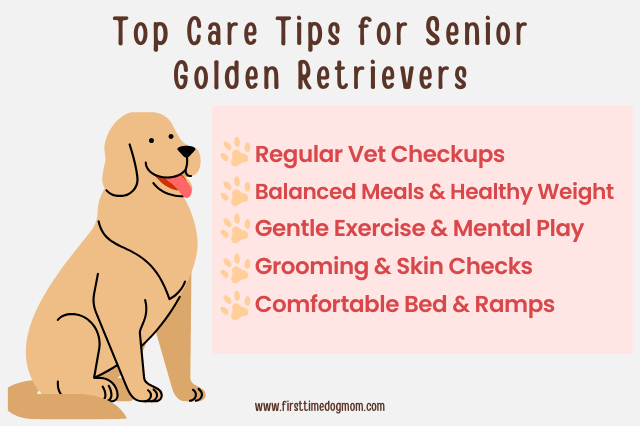
Even healthy senior Goldens may benefit from small changes in daily routines. Adjusting diet, exercise, grooming, and home setup can help your dog stay comfortable, active, and happy for longer.
Regular Veterinary Care
Senior dogs should see the vet at least twice a year for check-ups.
Your vet can spot early signs of health issues, adjust medications, and recommend preventive care.
This short video shows why regular checkups are so important for senior dogs:
Nutrition and Weight Management
Older dogs need fewer calories but still require enough protein to maintain muscle.
Feed smaller, balanced meals and monitor weight. If your dog is overweight, your vet can recommend a safe plan to slim down. You can also see our Healthy Weight Guide for Golden Retrievers for tips on maintaining a healthy weight. Adding supplements like glucosamine can also support joint health.
Exercise and Mental Stimulation
Shorter, gentler walks help maintain mobility. Swimming is excellent for dogs with arthritis. For other safe, low-impact exercises, see our guide on the Best Exercises for Senior Golden Retrievers.
Keep your dog mentally sharp with interactive toys, puzzle feeders, and games.
Grooming Tips
Older dogs may have trouble grooming themselves. Brush regularly to keep the coat healthy and check for skin changes or lumps.
Trim nails, clean ears, and bathe as needed to prevent discomfort or infection.
Comfort Enhancements
Small changes at home can make life easier for senior Goldens:
- Ramps or stairs for couches, beds, or cars
- Elevated food and water bowls to reduce strain on joints
- Orthopedic beds for joint support
- Non-slip socks or boots to prevent slipping
- Lift harnesses to assist with standing or climbing stairs
These adjustments help your senior Golden stay comfortable, mobile, and safe, making daily life easier for both you and your dog.
Quick Tips For Monitoring Your Senior Dog
Keeping a close eye on your senior Golden Retriever helps catch problems early and keeps them comfortable. Here’s a simple guide for daily and periodic checks.
Watch for Changes in Behaviour
- Slower movements or reluctance to play
- Increased sleep or unusual fatigue
- Confusion, pacing, or changes in house training
Check Their Body Regularly
- Coat and skin for dryness, lumps, or unusual growths
- Eyes for cloudiness, redness, or discharge
- Teeth and gums for signs of dental disease
Track Eating, Drinking, and Weight
- Monitor appetite and water intake
- Note any weight gain or loss
- Sudden changes can indicate underlying health issues
Mobility and Joint Health
- Observe stiffness when getting up or climbing stairs
- Look for limping or hesitation to jump or walk
- Gentle exercise helps maintain strength and flexibility
When to Seek Immediate Vet Care
- Sudden difficulty breathing
- Severe lethargy or weakness
- Unexplained bleeding or lumps
- Sudden loss of vision or hearing
Optional: Use a Checklist
- Keeping a simple checklist for daily or weekly monitoring can make it easier to spot gradual changes and share observations with your vet.
FAQs
Here are answers to some of the most common questions about aging Golden Retrievers and their health.
1. At what age is my Golden Retriever considered a senior?
Most Golden Retrievers are considered senior between 7 and 10 years old. Dogs 10 years and older are often called geriatric. Signs of aging can appear earlier or later depending on your dog’s health and lifestyle.
2. How can I tell if my dog is in pain?
Look for stiff movements, reluctance to play, limping, whining, or changes in behaviour. Older dogs may hide pain, so subtle changes can be important. If you notice these signs, contact your vet.
3. Can diet really slow aging problems?
A balanced, age-appropriate diet helps maintain healthy weight, muscle, and joint support. While it can’t stop aging, it can reduce strain on joints and prevent obesity-related issues.
4. How often should I take my senior dog to the vet?
Senior dogs should see the vet at least twice a year for check-ups, even if they seem healthy. More frequent visits may be needed for ongoing health issues.
5. What are the most common health problems in senior Goldens?
The most frequent issues include arthritis, cancer, dental disease, heart problems, diabetes, vision or hearing changes, hypothyroidism, muscle loss, and dementia. Watching for early signs can make a big difference in treatment and comfort.
Conclusion
Watching your Golden Retriever age can be emotional, but with the right care, their senior years can be happy and comfortable.
Here are the key points to remember:
- Watch for changes in behaviour, mobility, coat, and weight.
- Schedule regular vet check-ups at least twice a year.
- Adjust diet and exercise to maintain a healthy weight and support joints.
- Provide mental stimulation with toys, games, and puzzle feeders.
- Make the home comfortable with ramps, orthopedic beds, elevated bowls, and non-slip socks if needed.
- Address health issues early – arthritis, dental disease, heart problems, and cognitive decline are common but manageable with care.
Do you have a senior Golden Retriever? Share your tips or experiences in the comments.

Hi, I’m Jenny, the owner and content creator of First Time Dog Mom. As the proud owner of Ellie, my senior Golden Retriever, I share the insights and tips I’ve learned through my own experiences as a dog mom. With a lifelong love of animals, I hope to be a helpful resource for others navigating the joys and challenges of pet parenthood.
My husband and I have had 5 Golden Retrievers starting in 1994. They were all rescue dogs and each had different issues. Since all of them were rescues, they were about 6 years old by the time they came into our lives. It was sad that we didn’t get to know and love them longer, but each one was special and had different personalities. Our last one was a female, Lady, and she passed away 6 weeks ago. She was the sweetest. She had been a breed dog so knew nothing but having puppies! We had her for 4 years, coming to us when she was 7. She had the most health issues. About a year ago she started losing weight and found out she had developed Thyroid disease and IBS. She was placed on special dog food and had to eat 3 times a day. She had an enlarged heart and ultimately died from heart failure. We had no warning and she collapsed at the vet and couldn’t be revived. The sad thing is that we are senior citizens and can’t care for another Golden, but we have so many memories of each one of them. I like to think that we not only rescued Goldens, but they actually rescued us.
Hi Aquanetta,
Thanks for sharing your story with us. I am sorry for the loss of your last golden.
It’s wonderful that you have opened your home and heart to so many rescues.
Cherish all the memories.
Jenny.
Hi Jenny,
Our golden just turned 12 and seemingly out of the blue she started limping. Our vet said it was arthritis, but I failed to share that our son’s dog playfully bit her front leg several times. Could the bites have damaged her leg? When she walks her paw is folded under which seems extraordinary.
Do you have any suggestions?
Hi George,
Things seem to always happen suddenly and out of the blue when it comes to the health of our Golden Retrievers.
My female Golden, Ellie who is about to turn 9 in February suddenly started limping just this past week. She was fine the day before. The limp lasted for 1 and a half days then went away. I am certain she slept on it wrong, or had some sort of kink in her leg. Anyway, she is completely fine now.
In regards to your Golden, the limping could possibly be due to your son’s dog biting her leg and perhaps causing some pain or a minor injury. However, given her age, like your vet mentioned it could be arthritis as well.
I would discuss this further with your vet and mention that your son’s dog was biting her front leg. Your vet can then look for any signs of damage or muscle tear.
My other suggestion, if you aren’t doing so already, is to give your dog a high-quality joint supplement.
I started my Golden Retriever on a joint supplement at the age of 5. Not because she was showing any signs of joint issues, but as a preventative. I use Green Lipped Mussels powder, which is all-natural and has many other health benefits aside from being beneficial for the joints.
For more information on joint supplements and the ingredients to look for, please check out my article on joint supplements for Golden Retrievers.
Thank you so much for taking the time to comment and share your story. I hope your Golden gets better soon and that her limping is nothing too serious.
Take care,
Jenny.
My Jeanie just turned 11 last week. She has always been a fun-loving and friendly dog and I cannot imagine our life without her. That being said, we noticed some changes in the last month or so.
She is having problems with her eyes and I will be taking her to the vet next week (I wish it could be sooner).
She also has a lot of little lumps and bumps on her skin. Thank you for the information about skin tags, I just noticed a couple and wasn’t sure if they were the beginning of something more serious.
She is wary about stairs so we have changed her routine a bit to avoid the stairs if possible – especially in slippery weather.
Hopefully, the eye issues can be resolved but we are aware that there may be a time when she will need to be put down. We want to make her days comfortable and fun and full of love. Thank you so much for the informative article.
Hi Darryl,
I want to wish Jeanie a very happy belated Birthday!! I know exactly how you feel, as I cannot imagine my life without my sweet Ellie who is turning 8 very soon.
I know from fellow Golden owners that this breed has many eye issues, and I hope that it is nothing serious for Jeanie. A vet appointment that was sooner would put your mind at ease ( I totally get it).
Skin tags are super common with age, and appear out of nowhere. My Ellie has a couple on her as well that we are looking to have removed. I figure it is best to have them removed before they get too big. It is always best to have them checked out by your vet, just to be sure they are nothing to worry about.
All we can do is make every day the best it can be for our loving dogs! It’s hard to watch them slow down and get older.
Thanks again for taking the time to comment. I wish you all the best, and I’m keeping my fingers crossed for a good outcome with Jeanie regarding her eyes.
Jenny.
Although I cannot say about Golden Retrievers specifically, since I never had such a breed, a lot of these symptoms that you refer to apply to most dogs and in general we should pay attention to their health and well-being in order to give them the maximum life expectancy possible. They deserve it.
Hi Stratos,
Yes, absolutely, many of these health issues affect all dog breeds as they get older. Being aware of these issues will allow any owner to look out for any noticeable changes in their dog, and hopefully, give their aging dog the best life possible!
Thanks for sharing your thoughts.
Jenny.
Cogan is our second golden retriever. We brought her home at eight weeks and she is 15 years old and will be 16 in October 2021. She is beautiful, loving and the best companion ever to me and my husband. She is no longer so stable on her feet, so no going up to the second story anymore. We have stairs to help her get in and out of our SUV. She sometimes experiences some evening dementia, which has her pacing and circling for a short period of time. We find that being patient with her, brushing her, giving her commands rewarded with treats can help her settle and relax. She still enjoys walks, though they are now shorter so as not to overdo them. And she continues to look forward to her food. So pleased to see she still has quality to her life. We are focused on providing her with the love and care she has proven she deserves. I dread knowing that our time left is growing shorter, but how fortunate to have had my beautiful girl for so long.
Hi Kim,
Thank you so much for sharing your story. You certainly are fortunate to have your loving golden Cogan in your life for 15+ years, it is so nice to hear stories of goldens living past 10-12 years. Many owners are not so fortunate. It sounds like she is still doing amazingly well given her age, and you are certainly doing everything you can to give her the best life possible.
It is hard to witness your Golden Retriever slowing down with age, but the love that they give us seems to grow stronger.
I wish you and Cogan all the best.
Jenny.
My golden retriever is a very intelligent boy, very loyal, very loving and very handsome. He loves everyone and he is known as the dog father. Since the virus, he gets lots of visitors and has met new willing dog walkers. But sad to say he is 12yrs 4months old has cancer and ear and eye probs. But that is old age, comes to us all. Love him so much, good luck to all owners.
Hi Evelyn,
Thanks for sharing your story. Sorry to hear of your golden having cancer, unfortunately, this breed has a very high rate of cancer. It is their biggest downfall. It is sad for us dog owners to have to witness our loving dogs go through the ageing process, but yes it happens to us all. One thing is certain, no matter how sick or old a golden retriever gets, they will never stop loving you, being loyal to you, or stop giving you affection. I say it over and over again, this breed is the best!
I wish you and your golden many more happy memories together.
All the best,
Jenny.
This is a very informative article, and every bit you’ve mentioned is true. I have a golden retriever who is ultra playful and loves the outdoors. I would really be disheartened to see her slow down as she ages, but I guess that’s part of life. At the end of the day, I think it’s all about the quality of time we spend with our dogs now knowing that they live really short lives.
Hi AnnieTheGolden,
Thank you for taking the time to share your thoughts. It is a hard thing to watch when our beloved dogs slow down and aren’t quite as playful and energetic as they once were. When our pups go through the puppy stage we can’t wait until it’s over, but then we end up missing that stage. At what seems like the blink of an eye our once playful pup is slowing down. I agree with you that it is all about spending quality time with our dogs and making every moment count because life is just too short.
Jenny.
Thank you so much for this terrific and informative article. I, like your website’s name, am a first-time dog mom, having owned only one dog in my nearly 60 years of life. My beautiful golden boy Spencer, who we brought home at 8 weeks old and is now 12 1/2 years old in what feels like a blink of an eye, is showing signs of both liver and mobility problems. I am very emotional thinking about what the future holds and want to do the best I can to keep him happy for whatever time we have left. Thank you again for helping to remind me, and all of us, to enjoy each and every day with our wonderful golden babies.
Hi Sheryl, (fellow First Time Dog Mom),
I am sorry to hear that your beloved Spencer is having mobility and liver problems. It is a hard thing to watch, the ageing of our dogs. It happens so quickly, and our emotions start to take over. I am sure you will do everything you can to make Spencer feel loved, comfortable and happy. Sometimes the only thing that we can do for our pets is to be there for them and comfort them. Our dogs see us as their one and only, and just being there for them and cherishing every moment with them is truly what makes them happiest.
I wish you and Spencer all the best, and I want to thank you for taking the time to share your experience.
Jenny.
Sadly my beloved Goldie is near the end of his life. Born with hip dysplasia we have cared for him and he has got to the great age of 13years. Way beyond the vet’s prognosis! He has been an absolute joy to our family and I cannot express the absolute fear of losing him! Golden Retrievers are the most beautiful and loyal dogs. If you have one treasure them. Paddy is my second Goldie they are truly a joy to behold!
Hi Lynn,
Thank you for sharing your experience with your Golden, Paddy. It is hard to bear when you realize that your Golden is near the end, and I totally feel your fear! Losing a beloved pet is the hardest thing!! You must treasure all of the wonderful moments and memories that you have shared together, and you have certainly done a wonderful job of caring and loving your dog, 13 years is impressive for this breed. You have proven the vet’s prognosis wrong.
You have certainly proven that you are a Golden Retriever lover as this is your second one. They simply are the best breed! Like you said they are the most beautiful and loyal dogs.
I know you will continue to show your love and care to your Paddy throughout the end.
Thank you again for taking the time to comment, I wish you all the best.
Jenny.
This is an interesting read. I have a Golden Retriever who is currently if I am correct, midway of his lifetime and I’m prepping him for what’s to come through exercise and the right diet. I’m anticipating he’ll be getting one of these ailments when he ages. Hopefully not, but it’s a reality that cannot be avoided.
Hi,
Thank you for taking the time to share your thoughts. It is good to hear that you are taking the right steps in order to keep your Golden Retriever at his healthiest throughout his senior years. Exercise and feeding a well-balanced and high-quality diet are certainly the right things to do. It is good to be aware of what to expect as your Golden ages so that you can be better prepared for what’s to come. The ageing process is certainly something nobody can avoid, but as a dog owner, you can do everything possible to make life better for your Golden. I wish you many years of happiness and memories in the making with your Golden Retriever.
Thanks for your comment.
Jenny.
Interesting and comprehensive read. My Golden Retriever is now 13yrs and 4 months young. (Our previous Golden lived to 12.5years) He still loves to share his tennis ball, and play with his squeaky toys. But his two walks a day can take us 30-45 mins to go a fraction of the distance we used to. He has arthritis in his hips, many benign lumps and bumps, barks for no reason and his appetite is up and down. But he’s all the more precious to us. Doesn’t seem 5mins ago we brought him home as an 8week old puppy! They are the most loyal, gentle and loving dogs.
Hi Jane,
Thank you for sharing your experience with your beloved Golden Retriever. It is sweet that your dog still enjoys his tennis ball and squeaky toys, goldens really do stay young at heart! Time really does fly by when you own such a wonderful breed. I know the feeling because my Ellie is 4 years old and I still remember the very first day we brought her home. They truly are the most loving, gentle and loyal breed! It sounds like you are loyal to this breed as so many golden owners are. I will continue to own Golden Retrievers because they are simply the best!
I hope that you continue to have many more wonderful memories with your golden. Enjoy every moment with him!
Thank you again for sharing your thoughts and taking the time to comment.
Jenny.
WOW. Do animals equally develop grey hair? Never ever noticed that. Interesting finding.
It can really be heartbreaking to watch your beloved fluffy friend manifesting signs of old age. And I find this article particularly important because it will sensitize many people out there about what to expect from these good friends, and prepare accordingly in order not to expect too much from them anymore.
It seems the complications at old age are as many for dogs as they are for humans. Even though it’s something we cannot avoid, it will always be a sad transition, but when we prepare for it, the experience is manageable.
Your article provided just the right information to get ready. Thanks for sharing.
Hi Nsoh Alieh Laurine,
When dogs age they go through many similar changes as humans, even grey hair. You may not have noticed the grey hair on some dogs because of their already light coloured fur. Getting old is a hard transition for both dogs and humans, but being prepared for it does make it a bit easier.
Thanks for taking the time to comment.
Jenny.
I’ve never had a golden retriever and I’m shocked to learn they age faster than smaller dogs, and in fact, their lifespan is shorter than it was decades ago. That’s crazy! Decades ago it wasn’t uncommon to let your dog off a leash and run wild on your farm property and in the woods. I’m wondering if our obsessive need to keep our pets safe from all harm is causing more harm than good.
So though I haven’t had a golden retriever, I did have a beagle (who was obese) who ended up with arthritis so badly he couldn’t walk by the end at only 12 years old. My mother’s long-haired chihuahuas both passed last year at 15 and 17 years respectively. The 17-year-old was completely senile by that point, and deaf and partially blind. The younger one had a heart problem as she aged.
My mother is devastated still. We love our dogs. She had made beds and ramps for them. I’m happy to see you encouraging others in ways to care for a senior dog, like this post. Golden retrievers are one of the most loyal and smarter breeds, but they need help at the end, too.
Thanks for the post. Caring for a senior dog is hard, but so worth it, after years of love.
Hi Selenity Jade,
It is sad that larger dogs age faster than smaller dogs. The biggest fear for any Golden Retriever owner is cancer. Cancer is so prevalent in this breed, more than any other breed. No one really knows why the lifespan of goldens has shortened over time, but one could speculate that it has to do with environmental factors, bad breeding, and what we are feeding them. There are current studies going on to determine the causes. Hopefully, goldens will start living longer.
It is extremely devastating for any dog owner to lose such a loving family member, I am not surprised that your mother is still devastated. It takes a long time to heal from such a loss. All senior dogs need our love and support during their golden years to make their lives more comfortable.
I appreciate that you took the time to share your experience, thank you.
Jenny.
What a beautiful article! I owned a yellow lab and a golden retriever (at the same time). Such beautiful pets and family members. You hit it spot on with all the signs of aging. My retriever got cancer and my lab had organ failure. With tenderness we need to watch them and love them as they get old and help them through these stages. My lab would still try to chase a ball until the end. Thank you for this article.
Hi Tammy,
I am glad you enjoyed my article. Labs and Goldens are both wonderful, I am sorry about your loss. It sounds like your lab was still living life to the fullest. We really need to cherish every moment we have with our dogs and make sure they are comfortable and happy until the end. It sounds like you did just that!
Thank you for sharing your experience.
Jenny.
Very detailed information on Golden Retrievers. Coincidentally my first dog was a Golden Retriever. We lost her around the 10-year mark, but she was so playful.
I believe Golden Retrievers are one of the more fun dogs. We now own a Jack Russell Terrier he comes with his own issues.
But all the issues that you’ve listed out here about Golden Retrievers are very true, she started losing her eyesight around the eight-year mark I guess.
It was sad to watch her health decline. She had ingrained herself into our family so much that when we eventually lost her it was a huge family loss.
Towards the end of her life, we actually did use dog shoes for her as she would topple over. Thank you for all this information.
Hi Jag,
Thanks for sharing your experience with your Golden Retriever.
It is very difficult for any owner to see their dog slow down and get older and suffer from health issues. It must have been quite the adjustment when your golden lost her eyesight, not only for you but for your dog as well. Our dogs really become a huge part of our lives, and when we lose them it leaves us feeling so empty.
Thanks for taking the time to comment.
Jenny.