

Some of the links in this post are affiliate links. This means if you click on the link & purchase the item, I will receive an affiliate commission at no extra cost to you. All opinions remain my own.
Deciding when to spay a Golden Retriever is an important choice for their long-term health. Recent research from UC Davis shows that timing can affect growth, joints, and the risk of certain cancers, especially for this breed. Here’s what the study suggests about the best time to spay females and neuter males.
Table of Contents
Quick Answer: When to Spay a Golden Retriever
Female Golden Retrievers: The 2024 UC Davis study found that spaying female Goldens at any age was linked to a higher cancer risk compared to leaving them intact. Leaving females intact may be the healthiest option. If spaying, many vets recommend waiting until after the first heat (around 10–14 months).
Male Golden Retrievers: Neutering before 12 months has been linked to more joint problems. Waiting until at least 12 months supports healthier bone and joint development.
Important note: Timing should always be based on your dog’s health and lifestyle. Talk with your veterinarian before deciding.
Based on findings from the 2024 UC Davis study published in Frontiers in Veterinary Science.
How Sex Affects Spay and Neuter Timing
Golden Retrievers used to follow the general recommendation of spaying or neutering around 6 months. New research, however, shows that timing can have a bigger impact on growth, joints, and long-term health, especially since males and females develop differently.
Female Golden Retrievers
- Ovaries produce hormones that support bones, joints, and organs.
- Removing them too early can slightly increase the risk of certain cancers and joint problems.
- This is why timing, or leaving intact, matters for Golden Retrievers.
Male Golden Retrievers
- Testosterone helps males’ bones and joints develop properly.
- Neutering before 12 months can raise the risk of hip dysplasia and ligament injuries.
- Waiting until they are fully grown helps support stronger bones and joints.
Why It Matters: Golden Retrievers are a large, slow-maturing breed. Giving their bodies time to develop naturally can reduce some long-term health risks.
Is Leaving a Female Golden Retriever Intact an Option?

Yes, leaving your female Golden Retriever intact can be a healthy choice. Research shows that keeping her ovaries may help her grow properly and reduce some long-term health risks.
But it’s not just about health, it’s also about lifestyle and planning. If you decide to keep your dog intact:
- She will go into heat, usually once or twice a year, and it can last about three weeks. Learn more about your Golden Retriever’s heat cycle.
- During heat, you’ll need to watch her closely to prevent mating, which may mean limiting her access to other dogs.
- Some owners choose to spay for convenience or to make caring for their dog easier.
The bottom line: Leaving your female Golden Retriever intact is a valid option, but it does require careful management. Talk with your veterinarian about your dog’s health, your routine, and what will work best for both of you.
Pros and Cons of Spaying a Female Golden Retriever
Spaying your female Golden Retriever has both benefits and potential risks. Here’s what you should know so you can make an informed decision.
Pros of Spaying
- Prevents pregnancy: No accidental litters, which can save you stress and help control pet overpopulation.
- Eliminates heat cycles: No mess, no roaming males, and no hormonal behaviours that can be challenging to manage.
- Reduces risk of certain cancers: Spaying removes the uterus and ovaries, which lowers the chance of life-threatening infections like pyometra and some reproductive cancers. Read more about Why Golden Retrievers Get Cancer.
- Can improve long-term health: For some dogs, it may reduce the risk of hormone-related health issues later in life.
Cons of Spaying
- Surgery risks: Spaying is a major surgery, and anesthesia carries a small risk of complications.
- Hormone changes: Removing the ovaries affects hormones that support bone, joint, and organ development, especially if done too early.
- Potential weight gain: Many dogs gain weight after spaying if their food and exercise aren’t adjusted.
- Increased risk of certain conditions: Early spaying may slightly raise the risk of joint problems, some cancers, and urinary issues in large breeds like Golden Retrievers.
The bottom line: Spaying can be very beneficial, but timing matters. Waiting until your dog is mature (usually after her first heat) can help reduce risks. Talk with your vet about what’s best for your dog’s health and your lifestyle.
Types of Spay Procedures
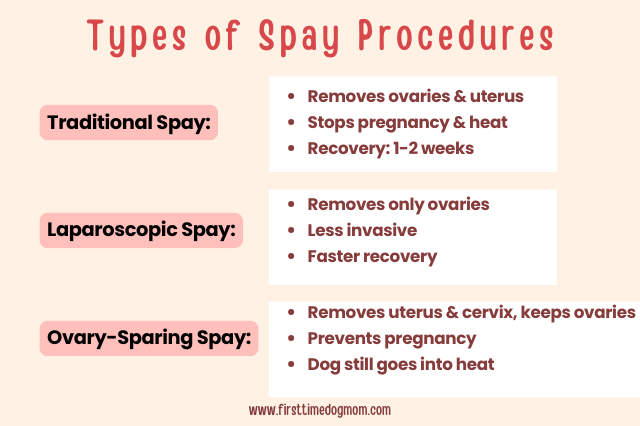
There are a few ways to spay a female Golden Retriever, and understanding the differences can help you make an informed choice with your vet.
1. Traditional Spay (Ovariohysterectomy)
- This is the most common method and involves removing both the ovaries and the uterus.
- It prevents pregnancy and eliminates heat cycles completely.
- Recovery usually takes a couple of weeks, and your dog may need restricted activity during this time.
2. Laparoscopic Spay (Ovariectomy)
- A less invasive option where only the ovaries are removed, often using a small camera and tiny incisions.
- Surgery time is shorter, recovery is faster, and the procedure may be less painful.
- Not all veterinarians offer this procedure, and it can be more expensive than traditional spays.
3. Ovary-Sparing Spay
- In this procedure, the uterus and cervix are removed, but one or both ovaries are left intact.
- Your dog cannot get pregnant, but she will still go into heat.
- Keeping the ovaries maintains natural hormones, which can benefit bone, joint, and organ development.
- This procedure is less common, and finding a vet who performs it may be challenging.
Key point: Each procedure has pros and cons. Talk with your vet about what’s best for your dog’s health, age, and lifestyle.
FAQs
Here are some common questions about spaying and neutering Golden Retrievers, to help you decide what’s best for your dog.
1. What is the best age to spay a female Golden Retriever?
If you choose to spay, wait until after the first heat, around 10–14 months. Research shows that leaving females intact may be healthiest for growth and long-term health.
2. Should I neuter my male Golden Retriever early?
Wait until at least 12 months. Early neutering can increase the risk of joint problems and affect bone development.
3. What are the risks of leaving my female Golden Retriever intact?
She will go into heat, and there’s a risk of pyometra, a serious uterine infection. You’ll need to monitor her during heat cycles.
4. Will spaying affect my dog’s weight?
Spaying can slow metabolism, which may lead to weight gain. Adjust food and exercise to keep your dog healthy.
5. Does spaying reduce the risk of cancer?
Spaying lowers the risk of pyometra and some reproductive cancers, but early spaying may slightly increase joint problems or other health risks. Timing is important.
Conclusion
Deciding when to spay or neuter a Golden Retriever isn’t one-size-fits-all. Timing matters for growth, joints, and long-term health, especially in this breed.
For many females, leaving them intact may support better joint health and reduce certain cancer risks. Male Goldens often benefit from waiting until at least 12 months for stronger bones and ligaments.
The best choice depends on your dog’s health, lifestyle, and your ability to manage an intact dog. Talk with a vet who knows Golden Retrievers to decide what’s right for your dog.
Have you already made this decision for your Golden Retriever? Share your experience in the comments below.

Hi, I’m Jenny, the owner and content creator of First Time Dog Mom. As the proud owner of Ellie, my senior Golden Retriever, I share the insights and tips I’ve learned through my own experiences as a dog mom. With a lifelong love of animals, I hope to be a helpful resource for others navigating the joys and challenges of pet parenthood.
I really am in a quandary about when to neuter my golden boy. I have been reading all the information and have spoken to my vet. My concerns are regarding joint issues down the road. He has advised me to neuter at 6 months since I have an intact Shih Tzu as well so that has the potential to be a little tricky. He also makes the point that there are more issues at play than just growth plates being effected by hormones. Other contributing factors can be diet (growing too fast), over activity and genetics to name a few. He also cautions about aggression developing in intact males which can be difficult to overcome. I have had several Labs in the long past that were spayed/neutered before a year who were just fine. But now the cancer consideration!!! Yikes! What to do????
Hi Duncan,
Ultimately the decision of when to neuter your male Golden Retriever is your choice. No one can make that decision for you.
I am wondering if your vet is up to date on the research studies performed on Golden Retrievers in regards to the effects of early spaying and neutering. Many vets are not up to date, and spaying and neutering affects different breeds. In large breeds such as Golden Retrievers, there is an increased risk of certain cancers and joint disorders if you spay/neuter too early. It is suggested (according to research studies by UC Davis), to hold off on spaying and neutering until a Golden Retriever is fully grown. They need their growth hormones to fully develop.
Of course, this is not always ideal for every single Golden Retriever, and it is always best to do your research and discuss the best option with your vet, as you have done. I do understand your dilemma, and it is not an easy decision to make.
If you haven’t already, please check out my article on neutering a Golden Retriever, as I go into more detail about the common misconceptions about neutering as well as the right time to neuter. I do link out to research studies conducted by UC Davis.
Please also know that spaying and neutering is just one of the many factors that can contribute to cancer in this breed.
I wish you all the best in making this decision.
Take care, and thank you for taking the time to share your thoughts.
Jenny.
I’m sitting here next to my English Cream Golden, and was so excited to see yours is Ellie too!
Our breeder gave us a very informative book and it explained well the risks and cons of spaying outweigh the benefits, overall. My Ellie is four years old and currently in heat, sporting cute re-usable cloth diapers within which we change out disposable pads.
We are planning to have her spayed before age five because of Pyometra but I had to search about it again and maybe do it a little sooner (had planned around her wellness exam in the fall) because I am bothered by a yucky odor she’s giving off.
She goes diaper-free at night so she can clean herself and of course when outdoors. Sorry if that’s TMI and I wouldn’t change my mind and have spayed her earlier due to the smell, that we don’t even always notice.
She’s in great health, though she does seem a bit low-energy for her age and breed. I believe their metabolism decreases even more after spaying, which I’m not sure was covered here (I admit I only skimmed.) Thanks for at least advocating waiting a bit longer. Our breeder had us sign a contract that we would wait until she was at least one year old, so she feels very strongly about that.
Hello L.,
Thanks for taking the time to share your thoughts. I believe most breeders if not all will have a contract that states owners must wait to have their dogs spayed or neutered. In regards to your Ellie being low-energy, some Goldens are just more laid back and calm as compared to others. Absolutely nothing wrong with that. My Ellie was pretty calm as well for a pup but certainly had her moments. And yes, it is believed that after spaying or neutering, a dog’s metabolism will decrease. This is the time that many of them will gain weight as well because owners feed the same amount of food, instead of making adjustments according to their dog’s activity and energy levels.
I want to thank you again for taking the time to comment, and I wish both you and your Ellie all the best!
Jenny.
Hi Jenny! I really enjoyed your article. Thank you for providing this!
I have a 14-month female golden. I am not sure what to do. There are no vets in my area that perform OSS. Would you do that one? Or the lap spay or the full spay? Should I wait for 2 years? I agree with you that I do want her to be spayed bec we live near parks and she goes to daycare sometimes.
Hi Laurie,
Thank you for reaching out. As with every type of spay or not spaying at all, there are risks and benefits that need to be carefully outweighed. You have already decided that spaying is the right choice for you and your Golden, now it is just deciding on the type of spay.
In all honesty, this is something only you can decide. Your Golden is 14 months old now, I would allow yourself a bit more time to do your research on the benefits and risks of each spay. Discuss the options with your vet to determine what is best for your Golden. I understand how difficult this decision is for any Golden Retriever owner, given the high rate of cancer in this breed.
I can only speak of my experience, which is my Golden was spayed around 6 months of age, as this is what was recommended by my vet at the time. I did not know any different. My Golden is almost 8 years old and is completely healthy. All I can hope for is that she continues to remain healthy and lives a long time. This is what every Golden Retriever owner hopes for their dog, but sadly nothing is guaranteed.
I am sure you will make the right choice for your female.
I wish you all the best, and thanks for taking the time to comment.
Jenny.
Very informative article.
We lost our 11-year-old Golden to Hemangiosarcoma (Spleen) we knew nothing about how/when spaying could later affect her life. We also knew nothing about HSA.
Our next Golden was spayed (traditional) after her first heat due to our Vet knowing about the Morris Foundation study as well as UC Davis. Well, we JUST lost her to HSA (heart) last weekend, a month short of her 9th birthday.
Hooked on Goldens, we are getting another one next Spring. Now looking into OSS..because the cancers are so prevalent. We thought we were okay with the late spay…not the case. Crossing my fingers, toes and paws that someone figures out how to beat this.
My first Golden lived to be 17 years old….now the lifespan is 10-12. I love Goldens but this is truly a heartbreaker.
Hi Cindy,
I am so sorry for the recent loss of your female Golden, 9 years old is just way too young! Cancer is horrible, and there really is no guarantee of how much time we have with our precious Goldens. All we can do is cherish each day we have with them.
Like so many Golden Retriever owners, we are hoping and praying that research and studies will bring us some much-needed answers and solutions on how to cure cancer in our breed.
It is devastating to lose such a loving dog and member of the family so quickly. Hemangiosarcoma is really a silent cancer as it spreads so rapidly and often without any clues!
Many of us, like yourself, are hooked on Goldens, once you own one, you will always own one. I am happy to hear that you are welcoming another one into your home next Spring.
Again, I am so sorry for your loss. I wish you all the best through this difficult time. Thank you for sharing your story with us.
Take care,
Jenny.
My golden puppy is 5 months old. My male golden is 6 years old. He is neutered. I will have to keep her in a room for 3-4 weeks during this time. It sounds like a nightmare. My first golden spayed early got Hemangiosarcoma and a torn ACL. My second was spayed early but not by me. She got bladder cancer. My male had one testicle in his abdomen so had to neuter. My holistic vet wants me to wait until after her first heat. I’m torn!
Hi Joan,
Thanks for sharing your experience with us. When it comes to spaying/neutering it is a difficult decision to make. It is ultimately your choice to decide what is right for your dog, and when the right time is. As you have shared with us, spaying early can have detrimental effects on the health of your dog. Waiting until after the first heat seems to be the consensus of many vets as well as breeders. You are certainly taking the right approach to it by doing your research and discussing this with your vet. I wish you all the best.
Take care,
Jenny.
I just had my collie puppy spayed. The breeder recommended not to have her spayed until she was at least 2 years of age. I had 2 golden retrievers which both were spayed at an early age and I lost both of them. One died with bone cancer the other her back legs gave out. I am getting a new puppy but will wait until she is older.
Hi Mary,
Thanks for sharing your experience. Sorry to hear about your Golden Retrievers, you didn’t mention at what age they were spayed or at what age you lost them. Spaying too early can certainly have ill effects on bone development, especially in large breed dogs like Golden Retrievers.
I wish you all the best with your collie puppy, as well as your new puppy.
Jenny.
Hello,
Thanks for your post about spaying Golden Retrievers with a lot of valuable information to help with this type of decision for a pet. I always wondered why I see some Golden Retrievers as well as other dogs gain weight on their back sides. Also, I had no idea about all the negative reasons why you wouldn’t want them spayed too early. This really gives me something to chew on about my dogs moving forward.
Best Regards,
Audrey
Hi Audrey,
There are many disadvantages of spaying your dog as well as doing it too early. Obesity can certainly be a cause of spay and neuter, but most often it is because the dog owner is over feeding and not providing enough exercise. Spaying early can cause many issues with joints etc., so it is important to be aware of all pros and cons and then deciding the best for your dog.
Thank you for sharing your thoughts.
Jenny.